
“The most exciting attractions are between two opposites that never meet”Andy Warhol
Frightening , scary and very worrying , what I have seen and heard, I have seen a person who, against to the wall , staring all passers-by, with a wicked and breeze look, begging with a whispering voice “please one dollar”. At the same time, I received a call from one friend who looking rather wealthy, he asked me,”I urgently need $ 1 million”.
Overwhelmed by this situation, I immediately drew the famous greenback from my portfolio to rediscover with a lot of “sur-realisme” the stakes, challenges and the mystery of what can be both abominable for some and adorable for others. Thus, too quickly, I remembered that magnificent image of polarity created by God, and which remains the everlasting source of creation ,whatever human, physical or metaphysical.
God created the universe against the backdrop of polarity, from the first moment when the cosmic manifestation started developing, duality was born. The first main duality is that of the manifest and the un-manifest. In the process of manifestation, the main polarity is that of mind and matter.
One important function of meditation is to awaken human consciousness about the various “pairs of opposites” that coexist in us and in the universe, the problems involved and the techniques to be used to balance them. Those “pairs of opposites” are great dualities between which “we live” and “we swing”, when we go either towards one or towards the other; For example: spirit-matter, joy-sadness, love-hatred. Every polarity is a relation between two elements and, as such, is never absolute but relative to a particular pair of opposites.
I – Adorable but Abominable, one mysterious duality of the Greenback
The same element can be both positive in its relation to a certain “pole” and negative in its relation to another; it can be useful, desirable and adorable on the one hand, dangerous, contemptible and appalling on the other.
How charming, exquisite, radiant, vital, impressive, pretty, soft and so attractive this little piece of green paper is ! It allows you to get the most out of life, appreciate beauty, love, meditate and enjoy the wealth of this world, savor life, change daily life into a sacred and turn the earth into paradise. It is truly magnificient! Nowadays “cash is king”.
Full of hatred, revolting, appalling, unpleasant, horrible, this same piece of green paper becomes develish, some would even kill to get it, it is at the origin of the worst scheming, master of all vices. It is appalling ! Nowadays “money is the root of all evil”
Thus, our dear Greenback, reamains on the one side Magnificient and on the other Appalling , we have trouble when we are in short, we have trouble when we have a lot! The financial abundance is having a lot of energy, the lack of wealth is seeking more energy, in both cases, Money provides you with energy.
Being an artist, I am interested in seeking a technique enabling to rebalance energy between abundance and shortage, between too much and too little, beyond the sociological considerations of wealth and poverty, it is the very definition of art that is raised … and therefore I should look for a “means” – which will bring together the desirable and the despicable, the rich and the poor, so that they are recognized and appreciated together … The Dictionary states that “art is the expression of an aesthetic ideal” … and that “aesthetics is the science of beauty.” However, the beautiful has never had any limits!
II – Images of wealth in Art
Money had a special place in the culture and imagination of artists. At the theater of my life backstages, I met a lot of people talking about money. It is the only prism of their existence, their sole motivation, their only value. I sometimes find myself thrown off as everyone seems to be talking a only about that. Every human act is assessed according to a new grid of monolithic identification which is money.
There is definitely a relationship between art and wealth … this relationship is not new … No need to go back further in history, we can quote Mécène, the minister of Emperor Augustus, who helped artists of his day and gave his name to the protection of arts … There was also Laurent de Medici in Florence in the 15th century, and of course the Kings of France, especially Francis I in the 16th century and Louis XIV in the following century, and many others … art has created wealth … Of course, artists have always “lived” thanks to their art: Leonardo da Vinci, Raphael, Fouquet, Rigaud , Ingres, Watteau, Delacroix, etc. Some artists even organized their “production” according to the customers, such as Rembrandt, who had many students and “finalized the work”.
For centuries, from ancient oriental art to Romanesque art, from the Middle Ages to the modern and contemporary times, wealth, like mythology, was a privileged theme for a very large number of artists.
Many remains of architecture, sculpture, painting and Roman mosaic are still drawing admiration. One only has to visit Rome, one of the most prestigious cities of art in the world, contemplate the richness of the monuments that make its glory and which go back to Antiquity, a wealth still remarkable over the whole Empire which it governed, from Scotland to the Sahara, from the Atlantic to the Euphrates.
Romanesque art is a compelling evidence of powerful people’s vice. It combines architecture as well as sculpture, painting or statuary of the same period. While it had evolved during a period of economic expansion, it was not the product of a single nationality or a single region, but had emerged gradually and almost simultaneously in several regions of Western Europe.

Moissac, the Saint-Pierre church, an example of a building that testifies, shortly after the year 1,000, to a new architectural trend encouraged by the great abbots and bishops’ concern to build for their city or monastery the most beautiful and richest sanctuaries of the world.
The best example that shows the close relationship between art and wealth was brought to me by a great expert in art history, my friend Licia Filingeri, who said « In the past, patronage was an economic and material support by sovereigns, aristocrats and possessors, to the artists. In the Italian Renaissance patronage is connected to the magnificence, so that the artists with their work gave luster to the Family of the aristocrats and rich men. I am thinking to Julius II della Rovere 1503-1513, one of the greatest pontifices and patrons of the Italian Renaissance, which commissioned to Michelangelo the magnificent fresco of the vault of the Sistine Chapel (1508-1512), what is now considered the masterpiece of the Renaissance Italian and one of the greatest masterpieces of art of all time »


The frescoes is divided into three sections. In the first three paintings, Michelangelo tells the story of The Creation of the Heavens and Earth; this is followed by The Creation of Adam and Eve and the Expulsion from the Garden of Eden; finally is the story of Noah and the Great Flood.
At the end of the 19th century Georges Seurat (1853-1891) French painter and draftsman of post-impressionism, gave a favorable image of society showing the rich and elegant circles “Sunday afternoon on the island of Grande Jatte “, a painting that ranks among the masterpieces as a testimony of the lifestyle during a period of great wealth.

In 1904, the famous French painter Henry Matisse (1869 – 1954) began his research on the theme of the Golden Age. With his painting “Luxury, calm and voluptuousness” shown at the chapel in Vence, he emphasized this great happiness of life, a happiness that he painted on a large canvas at the end of 1905, early 1906. Matisse was thirty-five when He painted “Joy of Life”, a large oil on canvas of 175 x 241 cm, currently safe at the Barnes Foundation in the United States.


Around the 1970s, Andy Warhol, the famous American artist and central figure in the art movement of Pop art, said highlighting the importance of money: “Making money is an art, working is an art and doing good business is the best kind of art”. His new aesthetic-anti-aesthetic ideal would have an impact beyond the New York avant-garde trend to influence and shape music, cinema, art and literature. The convergence between art and wealth was well marked in 1981, and Warhol, becoming a “businessman”, introduced his new series “Symbols of the Dollar” (Silkscreen and acrylic technique on canvas228.6×177.8cm). It was the expression of an obsessional love of glamor and wealth with more obvious artistic ambitions. Warhol wanted to turn the ordinary into extraordinary.

These examples show that, for decades, wealth in its different shapes and colors has been a topic widely represented in all artistic productions, it has never been a choice, the topic has been an aesthetic constraint for artists.
III – Images of poverty in Art
It was not until the nineteenth century, that the “social question” started to be raised, when the poor became “subjects” for painting, the peasant, and the worker later, could only be dirty, ravaged, close-minded, exotic, and disturbing. There were few writers who gave them the floor to express themselves or even refreerd to them: Villon, of course, for the “marginal” and the “simple”, Hugo, of course, Zola, Dickens … As for the painters, they painted mostly on request.
The sponsors were wealthy people who wanted to show God and society that they were good and rich believers, and later wanted to decorate their homes with testimonies of their greatness or nice images of the gentle world. The paintings rarely had the opportunity to depict those who were working, those who never looked presentable or those breadwinners by the sweat of their brows. There were, of course, exceptions: Murillo, Caravaggio, Le Nain brothers, La Tour, but most often the “people”, if they happen to be there, were a little pretty, a little charming, a little washed out.

The Young Beggar is one of the saddest paintings of Bartolomé Esteban Murillo (1645-1650). In addition to poverty, this child also suffers from loneliness: the austerity proves that he could only count on himself for this usual mother’s act. Murillo uses this gesture to emphasize the status of orphan. He was himself orphan at the age of 10. The painter was undoubtedly inspired by the appalling conditions preavailing in the streets of Seville in the Golden Age. Street children were a very common subject for Spanish painters of that time.

Several events, under the July monarchy, awakened the bourgeoisie’s thinking over people’s extreme poverty. It was between 1830 and 1840 that public awareness about urban and working poverty had risen. Norbert GOENEUTTE (1854 – 1894) introduced a charity scene “La Soupe du matin”. In the background, poor people – men, women in rags, children and old men – hurry in a cold morning to the distribution of soup kitchen. In the foreground of this courtyard, people are busy drinking hot beverage and look like scattered particles
The two painters wanted to show the true face of poverty, but with different styles.
Various realities are then described: poverty, misery (big shortage in goods), pauperism (poverty as an economic phenomenon related to industrialization). This revelation is the work of opponents of the regime.

At his early career Picasso sought to recreate archaic sources of art, he had succeeded in expressing the drama of misery through works such as the “Crouching Beggar” or the deep distress and the sulky air of the “The Barefoot Girl (1895) »
Nowadays, there is a frightening expression of poverty, it sounds like a gratuitous act, just like this willingness to help the other or to share something without seeking any profit, this hides this cursed desire to make nothing but money. Even the most trivial acts have become a source of mistrust, helping elderly people carry their heavy bags , holding the door to let a person come in … People are on the defensive, suspicious … the values that I have acquired through my classical strong education no longer valid or they are viewed as a deceit. Where have that chivalrous spirit, honor and dignity gone ?
Now, and thanks to our “sure- realism”, I should seek a rebalancing between abundance and shortage, too much and too little, the expression of wealth and that of poverty. Beyond their sociological considerations, I should find a “means” – for both rich and poor – to be recognized and well perceived together, hence the expression of a new aesthetic ideal. When we extend our field of vision in time and space to better understand this diversity and gather these opposites so as to unite all the inconsistencies. This mixture of opposites should free us from any standatdised forms because in reality everything is ephemeral, everything is variable in time and space.
IV – Mixing Images of Wealth and Poverty in Art, it’s “ADORAMINABLE”!
Once seated on my stool, in front of my canvas, wealth and poverty no longer reveal just charity , maintaining law and order or dealing with social, moral and political philosophy, but above all, another phenomenon, that of a perception that no longer stops only at the stage of a simple reception of the data coming from the real, but which seeks a deepened expression of the perceptual and cognitive stage, a perception which should touch upon a new knowledge, A new expression and a new “sure- realism.” It is a question of writing a new formula of orchestration: that of mixing so as to produce one “Symphony of an Adorable and Abominable Grenback”, as creation seems to reside in the general laws of contrasts.
First of all, we must recognize polarity, admit duality, balance opposites and learn to stand firmly in the center. This is a fundamental aspect of psychological and spiritual integration. This will allow me to stand on the stage, direct my instruments and orchestrate the Symphony of this mysterious greenback.
PLAYING THE MYSTERIOUS SYMPHONY :THE ADORABLE AND ABOMINABLE GREENBACK
With this symphony, it is no longer a matter of offering splendor to the new rich, as it has been done with the aristocrats in the past. The expression of wealth is not merely this favorite subject of artists.
With this symphony the expression of poverty deos not responds to that vulgar demand elaborated by rich sponsors who wanted to show God and society that they were good and rich believers!.
This symphony infringes this tendency , it is in breach of this unfortunate hypocrisy which has struck the art world, this symphony is at the same time the song and the apotheosis of the sincere expression of the “sure-realism”.
This is the synthesis of an encounter between admiration of Power and the contempt of impotence. It is the reconnection between the two oldest and most dangerous facets of human polarity, the power of the wealthy and the limits of the non-possessing.

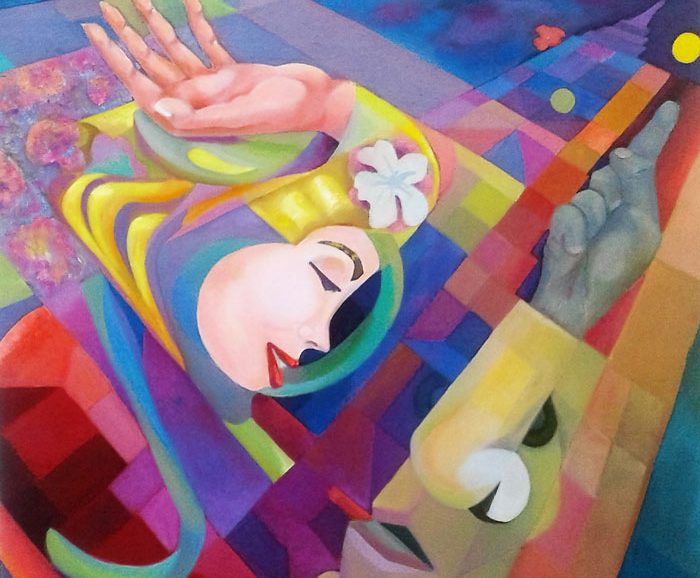
This Fourth Symphony is an orchestration directed by the Anamorphosis of the famous “Greenback”, thanks to the new form of the logotype, the two ends of the subject change giving the floor to twowonderful facets living together. In one side, one happy profile with the golden hair “color of splendor and luxury and bearer of power”which expresses “life in pink” beside the Empire state building at Manhattan, this profile is none other than that of the richest and most beautiful queen of Egypt “Nefretiti”, represented with bright and vibrating colors and intense light, a rich texture and an abundance of materials next to a decorative background ornmented by a series of flowers . And then , in the other side, the Deplorable Figurine,Cigarette tip in the mouth, with one contracted hand glued to the walls, which expresses cruelty and necessity , The set is represented in a broken and sharp lines, dirty smears of matter and a dull darkness against a background of poor monochrome dyeing. (The deplorable figurine is the Subject of my future project , a 3D urban memorial in the ” C.A center”, dedicated to the poor).
This Symphony includes a single instrumental duality that brings together in morphing the “painful social necessity” and “the wonderful human desire”. It is a matter of mixing the two ends of this duality and seeking an iconographic rebalancing, rebalancing abundance and shortage, too much and too little , the expression of wealth and the expression of poverty, the adorable and the abominable. It is the expression of creative duality, union despite difference, the fierce alliance of two opposites. It is the expression of a new “sure-realism”, a new aesthetic ideal.
Magical ! in life, everything can be at the same time adorable and abominable, all is relative, all seems to be “Adoraminable” !!! One should never neglect the usefulness of the various ingredients of the human recipe, never try to hide the colours of difference, never practice the policy of indifference,never deny or despise the existence of distinct forms, for nothing in the world is more productive than a sincere recognition of the worst difference, and nothing is more odious than zero ingratitude of dissimilarity.
Dear readers ! If you enjoyed this post, I’d love continue to share with you a variety of topics. You might enjoy my other posts, below .
I appreciate your comments and feeback. Thank you for your readearship
-THE MANIFESTO. A PLEA FOR THE NEW « SURE-REALISM »
-THE UMPTEENTH DIMENSION
-THE SYMPHONY OF OPPOSITES
– THE SYMPHONY OF LOVE « THE SACRED AND THE PROFANE »
– ON THE ARTIST AND POLITICS
-THE SPIRITUAL SYMPHONY
The author : Mourad Elloumi is a professional Artist-Painter and Professor Emeritus of Visual Art, he works to give art and architecture the status of humanities and sciences, thus enabling their authors to participate in philosophical and socio-political debates. For him, it is a matter of expanding the field of vision in time and space with the “UMPTEENTH DIMENSION” in order to better understand diversity, to gather and orchestrate the SYMPHONY OF OPPOSITES so that we can assemble the inconsistencies. This will help to better express the historical heritage and above all to harmonize cultural diversities. It is also a question of responding to the complexity of human nature characterized by a cocktail of realism and surrealism, expressionism and impressionism, and sometimes even abstract obsessions. New connections remain to be established in order to recreate a new result, a synergy between the different forms that reflect a new social or cultural “sure- reality” that is more extensive than the real of the moment,this is the way of the new “SURE -REALISM”.