
« WHEN THE PRODIGY’S MAGIC MIXES WITH REALITY, LIFE GETS BACK ITS ENCHANTING SIDE »
God has bestowed some people qualities that all gold owned by the powerful cannot match: genius and beauty. History has had its share of talent, and every day more and more talents are emerging. If it is believed that genius comes with time, training and experience, there are prodigies that have succeeded, despite their youth, in marking the magical scenery of the world.
We may believe in prodigies when they are convenient but when they are disturbing, they are banished as they were in the past – even by Christians – and throughout history: ” prodigies were for biblical times”; “Miracles have disappeared with the apostles‘ death “. Some go even further and consider miracles as being occult! Something we should hide or cover up.
Despite all this controversy, we shall always need these exceptionally talented people, who have an extraordinary precocious magic or supernatural talent, we need people who can achieve a feat and do amazing things, we need individuals who can do miracles, aspiring to create a better world, asserting that one man’s genius is other people’s happiness.
I- SPIRIT AND ART PRODIGES!
The development of means of communication and knowledge transfer shows that throughout the years we have seen more and more of these little geniuses whose fascination on humanity is not new. Whether they are outstanding mathematicians at an age when we normally have trouble counting on one’s fingers, very precocious geniuses of music or younger graduates, these prodigy children have developed extraordinary abilities at an early age … Some children are endowed with extraordinary abilities at a very young age.

Providing evidence of what has been said previously, here is an anthology of the youngest highly gifted in history. The Austrian composer, Wolfgang Amadeus Mozart, is one of the most famous children prodigies as his precocity was behind his legend. Born in 1756, he began to show exceptional gifts in music from the age of three. Two years later, he mastered the art of harpsichord. At the age of six, he composed his first musical pieces and at 11 he finished his first opera, Apollo and Hyacinthus. Achievement never equalled ever since ..

Ludwig van Beethoven, the famous German composer, born in Bonn on 15 or 16 December 1770 and died in Vienna on 26 March 1827, is another prodigy. His art had been conveyed through different musical genres, and even though his symphonic music was the main source of his popularity, he had an equally considerable impact in piano writing and chamber music overcoming, by a strong will, the hardships of a life marked by deafness that stuck him at the age of 27, celebrating in his music the triumph of heroism and joy while fate was holding isolation and misery for him. He was rewarded by Romain Rolland’s statement: “He is much more than the first of the musicians, He is the most heroic force of modern art2”. Being an expression of unalterable faith in man and of voluntary optimism, asserting musical creation as the action of a free and independent artist, Beethoven’s work has made him one of the most important figures in the history of music.

Michael Jackson was born on August 29, 1958 in Gary, Indiana, and died on June 25, 2009 (at the age of 50) in Los Angeles, California. He is a singer, dancer, choreographer, songwriter, actor and American director. Guinness record book describes him as being the most successful show artist ever. For Rock and Roll Hall of Fame, he is the most popular artist in the history of the entertainment industry. He was the seventh in a family of nine children, he started singing with his brothers at the age of six and began a professional career at the age of eleven in the Jackson Five, a group founded with his older brothers. While remaining a member of the group, he began in 1971 a solo career. Seven of his solo albums released during his lifetime are among the best-selling albums in the world: Off the Wall (1979), Thriller (1982), Bad (1987), Dangerous (1991), History (1995), Blood on the Dance Floor (1997) and Invincible (2001).
These geniuses of art have in turn marked the history of humanity through their talents, they had the merit of providing humanity with raw material for scientific experimentation, they have always been the first to change the traditional rules of all standardised forms, supernatural creators, creative to the extreme, they have been able to blur the boundaries between the imaginary and the real.
To explain this unlimited pleasure that these prodigies of art have been able to offer humanity, we had to start with rediscovering these Italian wonders of the Renaissance created by the giant of the Italian art MICHEL-ANGE, author of the work which it gave birth to a human genius, a universal genius, capable, at once, of embracing and pushing to perfection the arts of painting, sculpture, and architecture. God granted this privileged mortal still a high philosophy, and the gift of poetry, to show in him the successful model of all things that are worth our respect and honour.

Michelangelo’s frescoes are widely recognised today as being among the greatest masterpieces in the history of painting and as an incredible performance because of the extreme difficulty for only one man to paint with a flawless genius such a ceiling surface.

« Last judgement»
Michelangelo di Lodovico Buonarroti Simoni (Capri, 6 March 1475 – Rome, 18 February 1564), is a sculptor, painter, architect, poet and Florentine urban planner of the High Renaissance.
His work had such a considerable influence on his contemporaries that his “manner” of painting and carving had been widely taken up by representatives of the so-called Mannerism, which had developed during the late Renaissance, a demonstration of admiration that intellectuals and artists of his time had showed.
However, it was worth stressing THE GENIUS OF THE SMALL BOY WHO DREW LIKE RAPHAEL, the first young painter who finished his first recognized painting, entitled First Communion while he was only 15 years old, it is Pablo Ruiz PICASSO. Born in Malaga (Spain) on October 25, 1881 and died April 8, 1973 in Mougins (Alpes-Maritimes, France), painter, draftsman and Spanish sculptor having spent most of his life in France. When he was a little boy, he was an angel and a demon of beauty, you could not get tired of looking at him, “said his mother. During 91 years of life, Pablo Picasso made more than 60,000 works, a staggering figure which means that he made nearly 2 works a day throughout his long life.
Artist using various tools in his work, he is considered as the founder of cubism with Georges Braque and art companion of surrealism. He is one of the most important artists of the twentieth century in both his technical and formal contributions and his political positions. He produced nearly 1,885 paintings, 1,228 sculptures, 2,880 ceramics, 7,089 drawings, 342 tapestries, 150 sketchbooks and 30,000 prints (engravings, lithographs, etc.).

From 1907 to 1914, Pablo Picasso made Cubist works including the most famous painting, Demoiselles d’Avignon, made in 1906-1907, considered since then as the founding work of Cubism, just that! The year 1925 marked a turning point in the career of the artist when he started making paintings borrowed from horror, showing deformed and rabid creatures, as shown in the famous immortalized Kiss.

The Old Guitarist is an oil painting by Picasso, created late 1903 – early 1904. It depicts an old, blind, haggard man with threadbare clothing weakly hunched over his guitar, playing in the streets of Barcelona ( Spain).The Guitarsit Elements in The Old Guitarist were carefully chosen to generate a reaction from the spectator.For example,the monocromatic color scheme creates flat, two-dimensional forms that dissociate the guitarist from time and place. In addition, the overall muted blue palette creates a general tone of melancholy and accentuates the tragic and sorrowful theme. The sole use of oil on panel causes a darker and more theatrical mood. Oil tends to blend the colors together without diminishing brightness, creating an even more cohesive dramatic composition.
II – Music Celebrated by Painting Virtuosos
No one dares to speak of a pictorial symphony without admiring the works of these other prodigies of painting who celebrated music each in his own way, sometimes in solo and some othe times in concerto.

One of these wonderful interpretations is an oil painting (130 x 164 cm) dated 1655 – 1660 by Rembrandt Harmensz (1606-1669) where David playing the harp in front of Saul.
The topic is sensitive, moving, overwhelming. King Saul cries while listening to young David playing the harp as the beauty of the music touches on him and moves him to tears. He hides his emotion and tries to hide his crying and dry his tears in a curtain. The story is taken from the Bible, the Old Testament (Samuel 2nd book 16, 14-23, Jerusalem Bible, 408). Saul, the king of the Jews, though having a hard characted, is moved by the beauty of the melody played on the harp by a very young man, David. He listens to him while being touched by art, music, the sound vibration and the delicate touching of the strings. He is sensitive to the moment of grace he has seen and recalls the dark designs he has made on the destiny of young David. He’s crying, King Saul is crying!

The second masterpiece is entitled “The Beethoven Frieze”, first presented by Gustav Klimt in 1902: during the fourteenth exhibition of the Secession devoted to Beethoven’s music, Klimt exhibits a mural painting of 34.14 meters long and 2.15 meters high in seven panels1 representing the Ninth Symphony. This work represents the longing for happiness of the suffering humanity, looking for soothing in arts. In his mind, Klimt realizes a whole work of art, bringing together painting, music and architecture
In 1931, the famous surrealist painter, SALVADOR DALI presented Partial Hallucination. Six images of Lenin on a piano. It was through Music that Dali approached this political subject. The artist makes a fool of Lenin by multiplying his character and making him an increasingly pathetic figure. But this Lenin also represents the figure of the father. Behind the door is the maternal figure is looming, reminiscent of the paternal conflict. The pianist Dalí does not play. He would doubtless want to tap on the keyboard and thus on the head of Breton-Lenin and that of his father. But he cannot do that. It’s a mere hallucination. ”


The other great symphony is that of MARC CHAGALL, The Green Violinist (158 x 108.5 cm.1924) which is an oil on canvas exhibited in New York, Solomon R. Gugenheim Museum. In Green Violinist Chagall evoked his homeland. The artist’s nostalgia for his own work was another impetus in creating this painting, which is based on earlier versions of the same subject. His cultural and religious legacy is illuminated by the figure of the violinist dancing in a rustic village. The Chabad Hasidim of Chagall’s childhood believed it possible to achieve communion with God through music and dance, and the fiddler was a vital presence in ceremonies and festivals.

And to finish with these beautiful works, I must not forget “Young Girls at the Piano” by Auguste Renoir in 1892. “Young Girls at the Piano”, as the name suggests it, is a representation of two girls facing a piano, music is an art that Renoir chose to involve into his work. We can say then that in this painting, Renoir is mixing two arts which are painting and music. These are two different arts, but which also have their common points; for example, the communicative effect of both, the singularity present in each music and in each painting, as well as the fact that they covet both at least a part of the human body. Thus, we can say that music was an art dear to Renoir to which he gave importance. We can also see it in another work called “Woman Playing the Guitar”.
III- The Seventh Symphony: THE SOLO OF PRODIGE
Playing a “Solo” seems to be in total contradiction with the approach of the new ” sure-realism” which insists on the notion of opposition, affirms the expression of the duality, seeks the reorganization of the polarite and suggests the idea of “concerto”. Certainly, “sure-realism” is based on the idea of orchestrating diversity and harmonizing opposites, but refuses to merge opposites because merging two poles involves neutralizing their energy charges, hence a blurred and suspended identity. “Sure-realism” begins by preserving its roots path, keeping a certain singularity within a certain conception of diversity, it is a way to enrich the essential identity in a coherence of the group, a harmonious cohabitation of differences. This should explain my choice to play, in this seven symphony, one “Solo” and not a “concerto”.
WHY THE SOLO OF PRODIGY!
But what about female geniuses in history? Is there a reason why the majority of names associated with the word “genius” throughout history belong to men? If the prodigy woman was not mentioned as an example in this article, it is not because there were no women prodigies, it is not because of forgetfulness or inattention, but it is because I have been faithful to the tale of history, which has unfortunately neglected her and which hardly ever mention as a great example of knowledges , Not that there haven’t been female geniuses in history . There are names we hear often, such as Hypatia, Ada Lovelace, Marie Curie, Mary Shelley, and Rear Admiral Dr. Grace Hopper.There have also been many female geniuses whose history-making work didn’t come to light until much later, such as Rosalind Franklin’s discoveries regarding the structure of DNA, or the incredible African-American women of NASA, Dr. Katherine Johnson, Dorothy Vaughn, and Mary Jackson, whose contributions to the Space Program in the 1960s. Unfortunately the prodigious women did not have the chance to emerge, history was cruel with them and did not sufficiently mention their performances, the prodigy women were tyrannized, forgotten or thwarted in their career, throughout history, the prodigy women had unfortunately played in solo their knowledge and genius , for example, Clara Schumann (1819 – 1896), German musician and composer. Young prodigy, virtuoso pianist, she was largely overshadowed by the success of her husband. At the age of nine, Clara gives her first concerts. She played at the Gewandhaus Leipzig, a large concert hall of the city of classical and popular works. It’s not that female genius isn’t there. It may just come down to recognition.
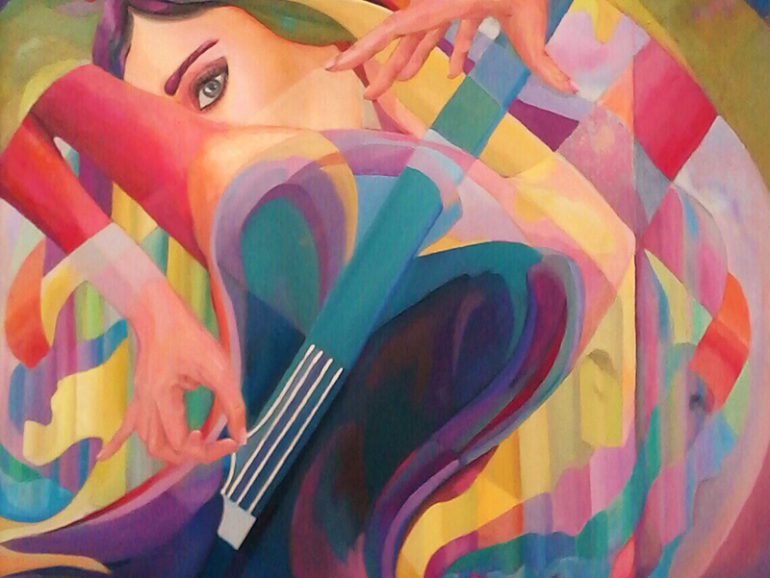
Thus, it is for a better recognition to the woman prodigy that I decided to paint this solo.Because women prodigies were humble and because we have to be grateful to their geniuses, we must offer them a “Solo of prodigy” that seeks to emphasize their intelligence even if their beauties were at all times the priority of painters.
This symphony chose a woman to orchestrate this canvas, she is the symbol of a young music prodigy whose talent was repressed by his father his broken hopes, the sacrificed prodigy is none other than Nannerl Mozart (Born in Salzburg, July 30, 1751 – died October 29, 1829 in Salzburg), this prodigy child, was a renowned musician of the time. Daughter of Leopold Mozart and Anna Maria Mozart, she was the sister of the composer Wolfgang Amadeus Mozart.

On the canvas of this solo and like the Seventh Symphony of Beethoven, the tension is gradually reinforced by the rise in rhythmic and harmonic power, the walls and frontiers between background and form disappear, the light reverses, bends and intertwines, the Beethoven’s violin poses naked, he calls us to the third fundamental law of Kybalion, which states that everything in the universe is vibration, movement, sensation and emotion. The prodigy keeps all his light in the midst of the contreversy human reactions especially those that criticized and condemned him.The rotundity around him symbolizes the Galileo heliocentrism (the Sun is at the center of the Universe), this other prodigy who was condemned by the Roman Catholic Church because he defended a theory considered as heretical.
Thus, different spatial fragments of history are brought together by the ” UMPTEENTH DIMENSION” to synthesize and reconstruct a new space and reaffirm the mystery of the prodigy. In finally, no matter what others say or do because when there is genius, it will eventually break through and remain forever in the memory of humanity.
What I liked most in this seventh and last symphony is the outcome of the implicit transfer of the astonishing theatrical meaning which Beethoven’s musical discourse art represents in a new fanciful image, this powerful and capricious art. with unpredictable changes, but always keeping this tremendous coherence, thanks to its freshness and agility, it is a symphony that expresses this innocent happiness barely darkened by a few rare accents of melancholy. Because I love with all my heart what a violinist prodigy exhibits, I vibrate all my joy in the movement of my forms and exalt all my happiness in the variety of my colors.Today, more than ever, art needs prodigies, where there is faith, where there is power, where there is love and beauty. “By madness, according to Shakespeare, we are learning essential things, going beyond the limits.”
Dear readers ! If you enjoyed this post, I’d love continue to share with you a variety of topics. You might enjoy my other posts, below . I appreciate your comments and feeback. Thank you for your readearship
-THE MANIFESTO. A PLEA FOR THE NEW « SURE-REALISM »
-THE UMPTEENTH DIMENSION
-THE SYMPHONY OF OPPOSITES
– THE SYMPHONY OF LOVE « THE SACRED AND THE PROFANE »
– ON THE ARTIST AND POLITICS ” lovers of Jerusalem”
-THE SPIRITUAL SYMPHONY
-THE SYMPHONY OF THE MYSTERIOUS GREENBACK
– THE CURSED SYMPHONY
– THE KISS OF A MAD SYMPHONY
The author , Writer or painter! Mourad Elloumi is an International Artist-Painter and Professor Emeritus of Visual Art, he works to give art and architecture the status of humanities and sciences, thus enabling their authors to participate in philosophical and socio-political debate. The first renaissance artists consider it necessary to combine their work with the writings that found their arts (such as the well-known mathematician, philosopher, painter and theorist – De picture- in 1435- Leon Battista Albert). His recent conceptual and plastic research of the « Sure-realism »meets that remarkable necessity of the renaissance years, a necessity that is unfortunately still neglected by a great number of artists today.